\[ \begin{align}\begin{aligned}\newcommand\blank{~\underline{\hspace{1.2cm}}~}\\% Bold symbols (vectors) \newcommand\bs[1]{\mathbf{#1}}\\% Differential \newcommand\dd[2][]{\mathrm{d}^{#1}{#2}} % use as \dd, \dd{x}, or \dd[2]{x}\\% Poor man's siunitx \newcommand\unit[1]{\mathrm{#1}} \newcommand\num[1]{#1} \newcommand\qty[2]{#1~\unit{#2}}\\\newcommand\per{/} \newcommand\squared{{}^2} \newcommand\cubed{{}^3} % % Scale \newcommand\milli{\unit{m}} \newcommand\centi{\unit{c}} \newcommand\kilo{\unit{k}} \newcommand\mega{\unit{M}} % % Percent \newcommand\percent{\unit{{\kern-4mu}\%}} % % Angle \newcommand\radian{\unit{rad}} \newcommand\degree{\unit{{\kern-4mu}^\circ}} % % Time \newcommand\second{\unit{s}} \newcommand\s{\second} \newcommand\minute{\unit{min}} \newcommand\hour{\unit{h}} % % Distance \newcommand\meter{\unit{m}} \newcommand\m{\meter} \newcommand\inch{\unit{in}} \newcommand\foot{\unit{ft}} % % Force \newcommand\newton{\unit{N}} \newcommand\kip{\unit{kip}} % kilopound in "freedom" units - edit made by Sri % % Mass \newcommand\gram{\unit{g}} \newcommand\g{\gram} \newcommand\kilogram{\unit{kg}} \newcommand\kg{\kilogram} \newcommand\grain{\unit{grain}} \newcommand\ounce{\unit{oz}} % % Temperature \newcommand\kelvin{\unit{K}} \newcommand\K{\kelvin} \newcommand\celsius{\unit{{}^\circ C}} \newcommand\C{\celsius} \newcommand\fahrenheit{\unit{{}^\circ F}} \newcommand\F{\fahrenheit} % % Area \newcommand\sqft{\unit{sq\,\foot}} % square foot % % Volume \newcommand\liter{\unit{L}} \newcommand\gallon{\unit{gal}} % % Frequency \newcommand\hertz{\unit{Hz}} \newcommand\rpm{\unit{rpm}} % % Voltage \newcommand\volt{\unit{V}} \newcommand\V{\volt} \newcommand\millivolt{\milli\volt} \newcommand\mV{\milli\volt} \newcommand\kilovolt{\kilo\volt} \newcommand\kV{\kilo\volt} % % Current \newcommand\ampere{\unit{A}} \newcommand\A{\ampere} \newcommand\milliampereA{\milli\ampere} \newcommand\mA{\milli\ampere} \newcommand\kiloampereA{\kilo\ampere} \newcommand\kA{\kilo\ampere} % % Resistance \newcommand\ohm{\Omega} \newcommand\milliohm{\milli\ohm} \newcommand\kiloohm{\kilo\ohm} % correct SI spelling \newcommand\kilohm{\kilo\ohm} % "American" spelling used in siunitx \newcommand\megaohm{\mega\ohm} % correct SI spelling \newcommand\megohm{\mega\ohm} % "American" spelling used in siunitx % % Capacitance \newcommand\farad{\unit{F}} \newcommand\F{\farad} \newcommand\microfarad{\micro\farad} \newcommand\muF{\micro\farad} % % Inductance \newcommand\henry{\unit{H}} \newcommand\H{\henry} \newcommand\millihenry{\milli\henry} \newcommand\mH{\milli\henry} % % Power \newcommand\watt{\unit{W}} \newcommand\W{\watt} \newcommand\milliwatt{\milli\watt} \newcommand\mW{\milli\watt} \newcommand\kilowatt{\kilo\watt} \newcommand\kW{\kilo\watt} % % Energy \newcommand\joule{\unit{J}} \newcommand\J{\joule} % % Composite units % % Torque \newcommand\ozin{\unit{\ounce}\,\unit{in}} \newcommand\newtonmeter{\unit{\newton\,\meter}} % % Pressure \newcommand\psf{\unit{psf}} % pounds per square foot \newcommand\pcf{\unit{pcf}} % pounds per cubic foot \newcommand\pascal{\unit{Pa}} \newcommand\Pa{\pascal} \newcommand\ksi{\unit{ksi}} % kilopound per square inch \newcommand\bar{\unit{bar}} \end{aligned}\end{align} \]

Dec 04, 2025 | 334 words | 3 min read

3.2.1. Task 1#

Learning Objectives#

By the end of this task, you will be able to identify conditions and implement conditional logic with confidence. You’ll learn how to interpret and analyze flowcharts that use decision blocks, allowing you to predict outcomes based on different inputs. Additionally, you’ll develop the debugging skills to help ensure that the logic in your programs or spreadsheets accurately reflects the decisions you intend to make.

Introduction#

In programming, you will often need your program to make decisions based on the conditions it is given. You can tell your programs when to make decisions by writing conditional statements into your program or spreadsheet. Conditional statements check if a condition is either True or False and then perform actions based on the outcome. In flowcharts, we represent conditional logic with diamond shaped decision blocks.

Task Instructions#

One team member should open the answer sheet ex3_team_1_teamnumber.docx, and save it with your team number replacing teamnumber in the file name. Working as a team, add your solutions for each part below to the document.

Part A#

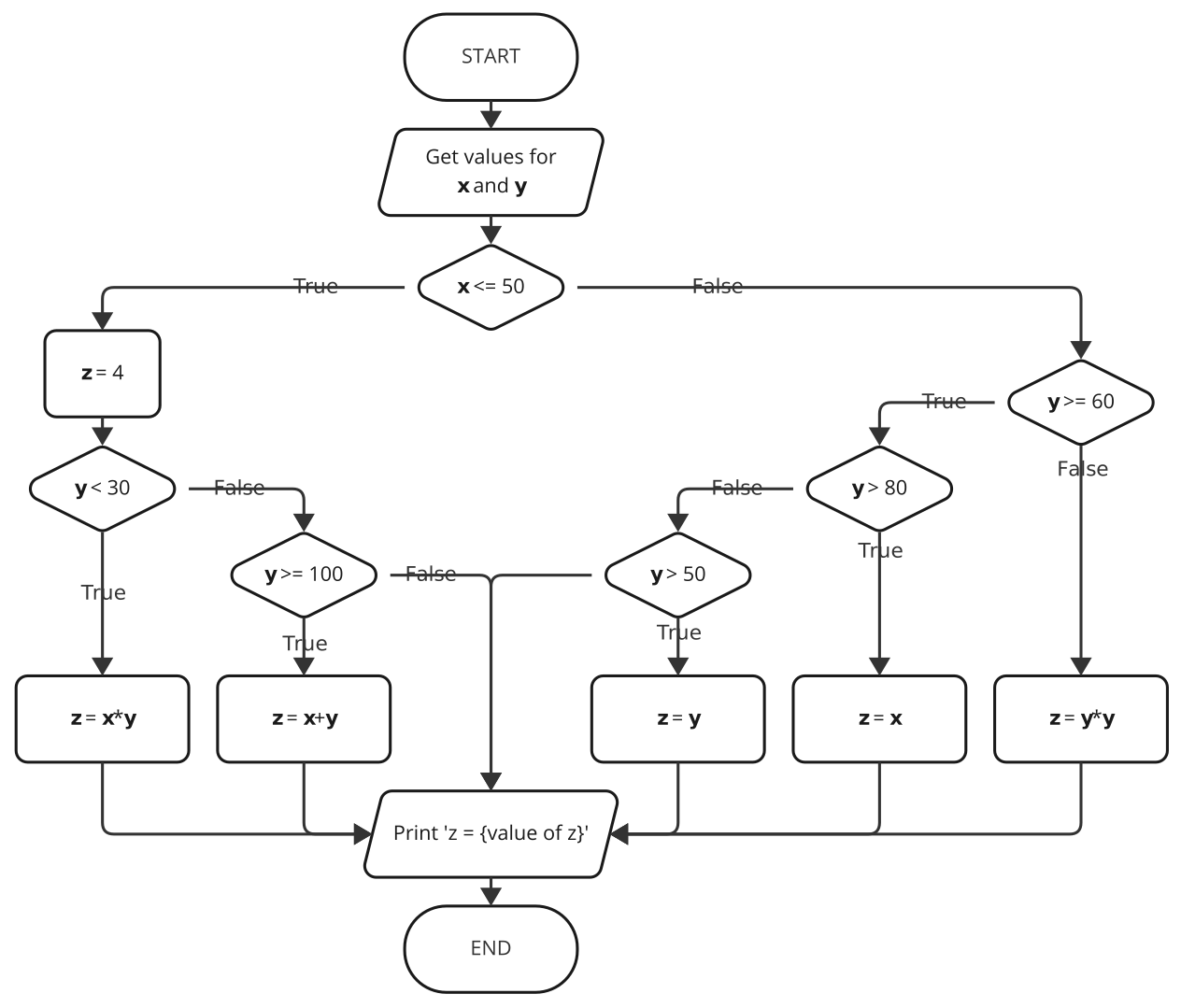
Using the flowchart below, determine the output \(z\) for each of the following test cases with inputs \(x\) and \(y\).

Table 3.5 Test Cases#

Case

\(x\)

\(y\)

\(z\)

1

\(40\)

\(40\)

2

\(20\)

\(20\)

3

\(55\)

\(20\)

../../../../../_images/flowchart.svg

Fig. 3.9 Flowchart for Part A.#

Part B#

Your team has been tasked with designing a program that determines the nature of the root(s) of a quadratic function of the form \(f(x) = ax^2 + bx + c\). The three possible outcomes depend on the value of the discriminant (\(b^2 - 4ac\)), and are summarized in Table 3.6. Create a flowchart for your program that takes \(a\), \(b\), and \(c\) as inputs, and uses decision blocks based on the value of the discriminant to determine the nature of the function’s roots.

Table 3.6 Discriminant Value#

Value of Discriminant

Roots

\(b^2 - 4ac > 0\)

two real roots

\(b^2 - 4ac = 0\)

one repeated real root

\(b^2 - 4ac < 0\)

two complex roots

Note

The roots of a quadratic equation of the form \(ax^2 + bx + c = 0\), where \(a\), \(b\) and \(c\) are real numbers, can be found using the quadratic formula:

\[x = \frac{{-b \pm \sqrt{{b^2 - 4ac}}}}{{2a}}\]

The term \(b^2 - 4ac\), is known as the discriminant and can be used to determine the nature of the roots of the quadratic equation.

Table 3.7 Deliverables#

Deliverables

Description

ex3_team_1_teamnumber.pdf

PDF of your completed MS Word document.